
Table of Contents
- Start With Your Why: Faith and Personality
- How to Choose Christian Clothing for Introverts: A Step-by-Step Guide
- How to Make Faith a Statement With Clothes (Without Feeling Loud)
- Conversation Starter Christian Shirts: The Quiet Witness Approach
- Styling Guide for Different Church Cultures
- Managing Energy and Social Anxiety During Church Events
- Common Mistakes to Avoid When Choosing Christian Clothing
- Conclusion: Wear Your Faith Your Way
- Frequently Asked Questions
Last Updated: September 19, 2026
Start With Your Why: Faith and Personality
Learning how to choose christian clothing for introverts starts with one truth: your quiet nature is not a flaw to fix.
Faith and Personality: Not a Contradiction
Scripture never asks you to change your wiring, only to be faithful with it. Moses argued with God about his slow speech. God still sent him.
- Solitude is a spiritual practice, not a weakness
- Listening is a spiritual gift, not a lack of boldness
- Depth is your default, and it builds real community
The Role of the Introverted Believer in Ministry
Quiet believers hold up the church in ways that rarely get applause: running the sound booth, preparing meals, remembering names. Ministry requires presence, not a microphone.
How to Choose Christian Clothing for Introverts: A Step-by-Step Guide
Christian clothing for introverts works best when it matches your church, your senses, and your comfort level. Here is each decision in order.
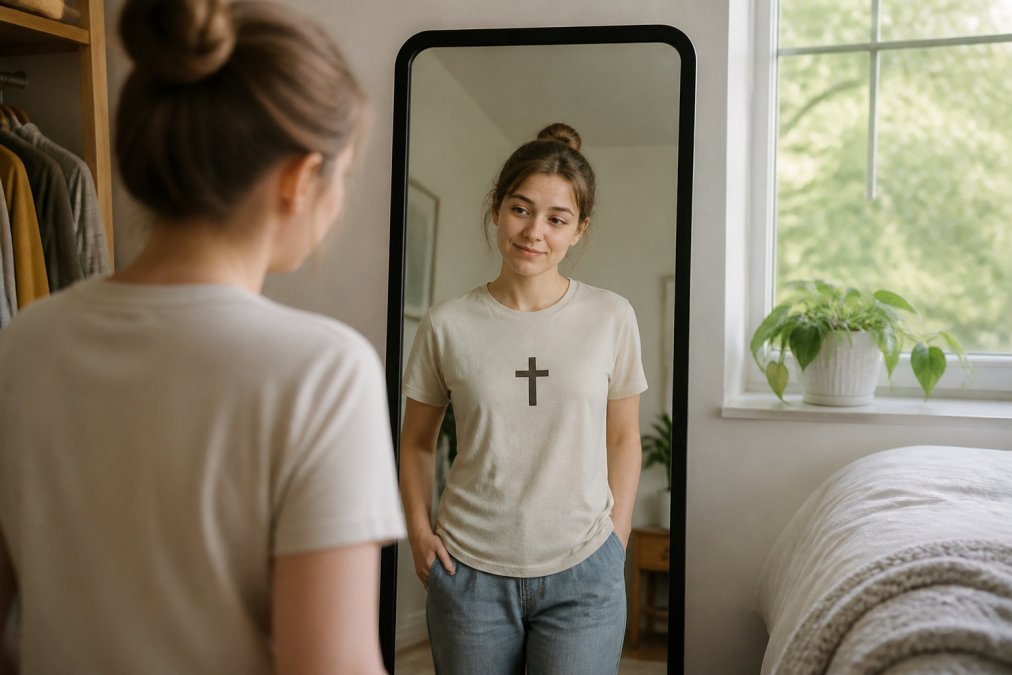
Step 1: Assess Your Church Culture and Dress Code
Start by reading the room. Spend one Sunday observing what people wear, how formal the service feels, and whether the room runs warm or cold.
- Traditional services: collared shirts, sweaters, modest silhouettes
- Contemporary services: tees, hoodies, denim, sneakers
- Small groups: whatever you would wear to a coffee shop
Step 2: Prioritize Sensory Comfort in Your Apparel Selection
Sensory comfort decides whether you actually wear the shirt. Look for soft cotton blends and tear-away labels, and mind the weight: a 6 oz. cotton tee feels different from an 8 oz. fleece crew.
- Tear-away labels stop neck irritation
- Cotton and poly blends breathe and hold shape
- Ribbed cuffs keep sleeves in place without squeezing
- Loose classic fits reduce that trapped feeling
Step 3: Use Clothing as a Social Buffer
That is the quiet witness approach: you stay yourself, and the message does the work.

How to Make Faith a Statement With Clothes (Without Feeling Loud)
Making faith a statement with clothes is about clarity, not volume. Start with one anchor piece: a well-made tee or hoodie carries your message further than five cheap items.
- Choose one message you actually want to talk about
- Keep the rest of the outfit simple and neutral
- Repeat the piece often so people connect it to you
- Let the design invite questions instead of forcing answers
Conversation Starter Christian Shirts: The Quiet Witness Approach
Conversation starter christian shirts open doors rather than preach. The best ones give others a natural reason to ask: someone reads your shirt, smiles, and asks what it means.
- Question-based designs invite a response
- Short phrases are easier to read and remember
- Clean fonts beat cluttered artwork every time
Styling Guide for Different Church Cultures
Different rooms call for different looks, and introverts feel that mismatch sharply. The goal is not to look fashionable but unremarkable in the best way, appropriate enough that no one stares, distinctive enough that you still feel like yourself. Sort your church into one of three formality tiers; the tier decides almost everything else.
Tier 1: Traditional and Liturgical Settings
Expect suits, dresses, collared shirts, and a slightly formal room. The quiet-witness move here is a message on a small canvas: a subtle embroidered word, small chest print, lapel pin, or bracelet. Large graphics read as casual and can make you feel exposed.
- Base layer: collared shirt or fine-knit sweater in a neutral tone (navy, charcoal, cream, olive)
- Message layer: small chest print, embroidered detail, or a subtle accessory
- Bottoms: tailored slacks, midi skirt, or dark denim without distressing
- Shoes: loafers, oxfords, or clean flats
- Why it works: the message is discoverable rather than broadcast, which matches the room's tone and gives you a natural, low-pressure opening if someone leans in to read it
Tier 2: Contemporary and Casual Settings
Expect tees, hoodies, denim, sneakers, and a warm, social room. Here a clear, readable message tee does the most work, because the shirt becomes the introduction you did not have to make.
- Base layer: a 6 oz. cotton or cotton-poly tee in a classic fit
- Message layer: one clear phrase, clean font, high contrast against the shirt color
- Bottoms: dark or mid-wash denim, joggers, or chinos
- Shoes: clean sneakers
- Why it works: the casual room already expects graphic tees, so your message reads as normal rather than performative, and normal is exactly what an introvert wants in a crowd
Tier 3: Small Groups, Bible Studies, and Home Gatherings
Expect coffee-shop wear in a close, conversational room. This is the tier where you can go boldest, because the group is small enough that a conversation starter will land.
- Base layer: hoodie, crewneck, or flannel over a plain tee
- Message layer: a fuller phrase or a design with a little more personality
- Bottoms: joggers, jeans, or leggings
- Shoes: anything comfortable
- Why it works: in a small room, a message tee is not a billboard, it is a natural topic, and you have the time and quiet to answer at your own pace
The Formality Rule That Saves You
When unsure, dress one notch above the room's average, not two. One notch reads as respectful; two reads as trying too hard, which draws exactly the attention an introvert avoids.
A Quick Fit and Fabric Checklist
Fit and fabric matter more than the graphic: a great message on an uncomfortable shirt never gets worn twice.
- Shoulders: seam should sit at the edge of your shoulder, not past it
- Collar: should not touch your throat when you swallow
- Tags: tear-away or printed, never scratchy woven
- Fabric weight: 6 oz. for warm sanctuaries, 8 oz. fleece for cool ones
- Color: pick two or three neutrals you actually like and build around them
Matching the Message to the Moment
Not every service calls for the same message. Keep two or three pieces in rotation, one subtle, one clear, one warm layer, and let the occasion pick for you, so you are never scrambling in front of the closet on Sunday morning.
Managing Energy and Social Anxiety During Church Events
Social anxiety in church is common and does not mean your faith is weak. It means your social battery drains faster than most. The fix is not to toughen up but to plan your energy like you plan your outfit.
Why Church Drains Introverts Specifically
A typical service stacks several stressors at once: a crowd, ambient noise, warm air, unfamiliar proximity, and the expectation to greet people before and after. Together they compound, so by fellowship hour your tank is often half empty. You do not need to fix the whole morning, only protect the two or three moments that matter most.
Dress to Reduce Sensory Load
Clothing is the most controllable variable in the room, and a few adjustments cut background discomfort significantly:
- Choose breathable fabrics. Cotton and cotton-poly blends move air; heavy fleece traps heat and makes a warm sanctuary feel suffocating.
- Skip tight collars and cuffs. A collar that touches your throat or a cuff that squeezes your wrist creates a constant low-grade distraction you cannot stop noticing.
- Go with tear-away or printed labels. Scratchy woven tags are a classic sensory trigger, and they are easy to eliminate.
- Pick a classic, slightly relaxed fit. A shirt that feels like it is holding you in adds to the trapped feeling a crowded room already creates.
- Layer for temperature control. A light cardigan or overshirt you can remove gives you one small piece of control over your environment.
Use Your Outfit as a Social Script
A message tee gives you a pre-written opening line. When someone reads your shirt and asks about it, the conversation starts on a topic you already chose. That shift, from initiating to responding, is the biggest energy saver available to an introvert, and it is the same mechanism that makes the quiet-witness approach work.
A Practical Energy Plan for Sunday Morning
Plan the morning in blocks, each with a job:
- Before you leave: eat something, drink water, and give yourself ten quiet minutes. Do not start the day already depleted.
- Arrival: aim to be five to ten minutes early so you can settle into a seat before the room fills. Late arrival into a full room is the highest-anxiety version of the morning.
- During the service: sit where you can breathe, an aisle seat or a back row is not a lack of faith, it is good stewardship of your attention.
- Fellowship hour: set a realistic time limit before you walk in. Ten focused minutes of real conversation beats forty minutes of white-knuckling.
- Exit: leave when your limit is up, without apology. A clean exit protects your ability to come back next week.
Small Scripts That Lower the Pressure
Two or three short phrases ready removes the panic of not knowing what to say:
- "I'm glad I caught you, I wanted to say hi before the crowd builds."
- "I'm going to grab some air in a minute, but I wanted to check in first."
- "I love that shirt, where did you find it?" (works on anyone, and it hands them the talking)
When to Step Out, and Why It Is Not Failure
Stepping outside for two minutes is not abandoning fellowship; it is resetting so you can return. A short walk or a few breaths in the parking lot can restore enough energy to finish the morning well and come back next week.
Common Mistakes to Avoid When Choosing Christian Clothing
Most wardrobe regrets come from a few predictable choices.
- Buying too bold too fast. Start subtle, then build up.
- Ignoring fabric weight. Heavy fleece in a warm sanctuary feels miserable.
- Choosing clever over clear. If people cannot read it in two seconds, it will not start a conversation.
- Skipping the fit check. A great message on a bad fit still looks bad.
- Buying for someone else's church. Your friend's culture is not yours.
A common mistake is treating faith apparel like a costume. It is everyday clothing with a purpose. Our pieces are built on soft cotton blends and tear-away labels.
Conclusion: Wear Your Faith Your Way
Choosing what to wear should not feel like a test you might fail. Your personality is not an obstacle to sharing your faith. It is the shape your witness takes.
Frequently Asked Questions
Can wearing faith-based clothing help introverts start conversations?
Yes, because it gives others an easy opening. A shirt with a clear message like 'Blessed' or 'Saved but...' invites questions without you having to initiate. You can keep your answer short and sincere. Many introverts find this less draining than starting from scratch. The clothing does the initial work, and you respond at your own pace.
What should I look for when buying Christian t-shirts for everyday wear?
Check the fabric weight and material. A 6 oz. 100% cotton tee like the Blessed Tee ($23.13) holds up well and feels substantial. Look for a tear-away label and double-needle stitching for comfort and durability. Also consider the message: is it clear enough to spark curiosity but not so loud that you feel self-conscious? Fit matters too, so review the size chart.
How do I balance modesty and personal style as a Christian introvert?
Modesty does not mean shapeless or boring. Choose well-fitting pieces that cover appropriately while reflecting your streetwear or minimalist taste. A classic crewneck sweater like the Blessed Sweater ($28.75) pairs with jeans or joggers. The goal is to feel comfortable and true to yourself, not to hide. Your style can be both modest and expressive.
Are there any colors you shouldn't wear to church?
There is no biblical rule against specific colors. Some traditional churches prefer darker, subdued tones for reverence, while casual or contemporary services welcome any color. If you're unsure, observe what others wear and match the general tone. Otherwise, wear what makes you feel confident and respectful. Colors like black, grey, and navy are safe choices for introverts who prefer to blend in.