
Table of Contents
- Why Graphic Tee Designs Fade and Crack (And What Speeds It Up)
- How to Wash Graphic Tees Without Damaging the Print
- How to Dry Graphic Tees So the Print Stays Intact
- How to Prevent Shirt Prints From Cracking Over Time
- How to Store Graphic Tees to Protect the Design
- Matching Care to Print Method and Fabric Type
- Conclusion: Keep Your Graphic Tee Designs Talking for Years
- Frequently Asked Questions
Last Updated: October 13, 2026
Why Graphic Tee Designs Fade and Crack (And What Speeds It Up)
A graphic tee is only as good as the print on its front. Most designs fail not because of the printer, but because of how the shirt gets washed: heat, friction, and harsh detergent break down the ink or vinyl layer, and once it lifts, nothing brings it back.
At Saved, not finished, we build our faith-inspired tees around designs meant to spark conversation for years, not weeks. What wears a design down:
- Heat from hot water and high dryer settings softens and shrinks the print layer
- Friction from other clothes rubbing against the design in the wash
- Harsh detergent and bleach that eat into the ink over time
The good news: every one of these is controllable. The American Cleaning Institute's laundry guidance points to the same basics we recommend to our own customers: lower heat, less agitation, and gentler products.
How to Wash Graphic Tees Without Damaging the Print
Washing is where most print damage happens. The routine we recommend:
- Turn the shirt inside out before it goes anywhere near the machine
- Wash in cold water on a gentle cycle
- Use a mild detergent with no bleach or fabric softener
- Keep the load small so the shirt is not rubbing against heavy items
- Skip the dryer entirely if you can
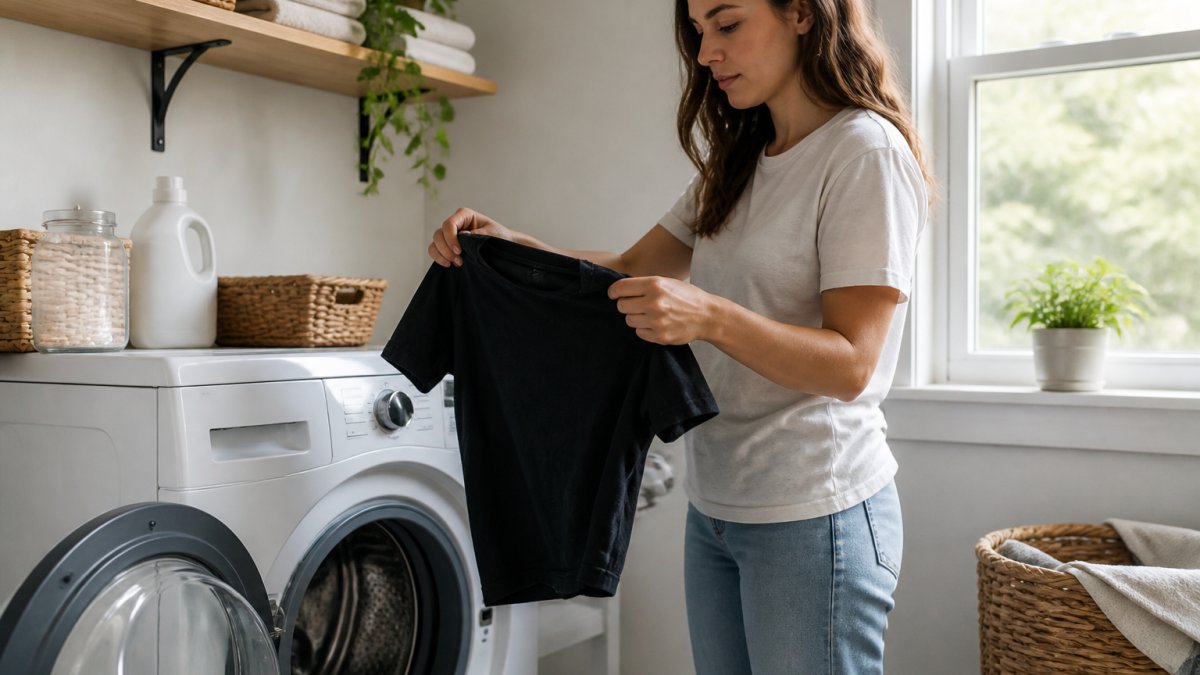
Water Temperature, Detergent, and Cycle Settings That Matter
Cold water is the single most protective setting for any printed design: heat breaks down the bond between ink and fabric, so a cold wash slows that breakdown. A mild, bleach-free detergent does the rest, since bleach and fabric softener both attack print layers and softener leaves a residue that dulls colors. A gentle cycle with similar-weight items keeps friction low.
Why Turning Your Tee Inside Out Makes a Difference
Turning a graphic tee inside out protects the print from direct contact with the drum and other garments: the design faces inward, so the fabric takes the abrasion instead of the ink. It is the difference between a print that lasts years and one that cracks in months. Pair it with a cold, gentle cycle and you have covered the two biggest causes of print wear.
How to Dry Graphic Tees So the Print Stays Intact
Air drying is the safest way to dry any printed shirt. Heat and tumbling are hard on print layers, so the less of both your design sees, the longer it lasts.
To air dry a graphic tee:
- Lay it flat or hang it on a line, design side up
- Keep it out of direct harsh sunlight to protect the colors
- If you must use a machine, choose the lowest heat setting
Air Dry vs. Tumble Dry: What Works Best for Printed Designs
Air drying wins for print durability. Tumble drying adds heat and motion, the two things that speed up cracking and peeling.
| Drying Method | Heat Level | Print Risk | Best For |
|---|---|---|---|
| Air dry (flat or line) | None | Lowest | All printed designs |
| Tumble dry, low heat | Low | Moderate | When you need it dry fast |
| Tumble dry, high heat | High | Highest | Avoid for printed tees |
If you have to use a dryer, low heat and a short cycle is the compromise. Never high heat.
How to Prevent Shirt Prints From Cracking Over Time
Prevention is a habit stack, not a single trick. But the skill almost no care guide covers is knowing what to do once damage has started. Here are the habits that keep a print intact, plus a triage for prints already showing wear.
The prevention habits that actually move the needle
- Wash less often. A graphic tee does not need a full wash after one wear if it is not soiled or smelly. Spot-clean small marks and air it out between wears; every wash is another round of heat and abrasion.
- Never iron directly on the design. If the shirt is wrinkled, iron it inside out, or place a thin cotton cloth or parchment between the iron and the print. Direct contact with a hot iron is the fastest way to melt or glaze a print.
- Skip dry cleaning. Solvents can attack the adhesive on heat-transfer prints and dull DTG color. If a care label says dry clean only and the shirt has a print, hand-wash cold instead.
Troubleshooting a print that is already damaged
Damage type matters, because some problems are reversible and some are not. Here is how to tell them apart.
Early cracking (hairline lines along fold points). Usually the first stage of plastisol or DTG wear.
Overall fading with no cracking. Usually UV or detergent damage, not mechanical wear, and it cannot be restored.
A print that has flaked or chipped off in patches. End-stage failure.
A simple durability check you can run yourself
To know how well a shirt is holding up, check the same three spots each cycle: the highest fold point on the chest, the edge of the print nearest the collar, and the area under any bag strap. Photograph them in the same light every few months. Visible hairline cracks, a chalky surface, or a lifted edge are the three measurable signs a print is deteriorating.
How to Store Graphic Tees to Protect the Design
Storing a printed tee correctly keeps the design from creasing, sticking, or rubbing against itself. Fold the shirt with the design facing inward. For long-term storage:
- Fold rather than hang, hangers can stretch the shoulders and distort the print
- Keep shirts in a cool, dry place away from direct sun
- Avoid stacking heavy items on top of a printed design
Matching Care to Print Method and Fabric Type
Most care guides treat every graphic tee the same, which is the single biggest reason prints fail early. A screen print, a direct-to-garment (DTG) print, a heat-transfer vinyl, and a sublimation print are four different physical systems on (or inside) the fabric, and they fail in different ways. Match your care to the print method first, then the fabric.
How each print method actually behaves
- Screen printing (plastisol ink): A layer of ink cured onto the fabric surface. The most durable common method, but plastisol sits on top of the weave, so it can crack along fold lines if repeatedly tumble-dried or ironed directly. Cold wash, inside out, air dry, and it outlasts the shirt.
- Direct-to-garment (DTG): Water-based ink jetted into the fabric and bonded with a pre-treatment and heat press. Softer than plastisol but more sensitive to abrasion and residue. Skip fabric softener and dryer sheets entirely, they leave a coating that dulls DTG color faster than screen print. Wash cold, inside out, low agitation.
- Heat-transfer vinyl (HTV) and transfer prints: A vinyl or film layer pressed onto the fabric with adhesive. These lift at the edges first, and the failure mode is peeling, not cracking. Never tumble dry above low, never iron directly on the design, and never dry clean, since solvents can soften the adhesive. If an edge lifts, a protective cloth and a low iron can sometimes re-press it.
How fabric changes the equation
The print is the fragile part, but the fabric underneath controls how heat and abrasion reach it.
- 100% cotton: Absorbs ink well, holds screen print and DTG crisply, and is prone to shrinkage in hot water or a hot dryer. Shrinkage pulls the fabric under a cured ink layer, a common cause of hairline cracks that look like print failure but are actually fabric movement. Wash cold and air dry.
- 100% polyester: The natural home of sublimation. Smooth surface, low shrinkage, but polyester is heat-sensitive, so high dryer heat can glaze or distort a print. Low heat only.
- Cotton-poly blends (50/50 and similar): A compromise fabric. Blends shrink less than pure cotton, which helps print stability, but the surface texture is less uniform, so DTG and screen print can look softer or less crisp from day one. Follow the print method's care rules, not the fabric's.
A quick decision rule
If you do not know the print method, look at the print surface. A raised rubbery layer means screen print or HTV: cold wash, inside out, no dryer. If it feels like part of the fabric with no edge, treat it like DTG or sublimation: cold wash, inside out, no fabric softener, air dry. When in doubt, the gentlest setting that still gets the shirt clean is right.
Our own tees, like the Working On The Rest Tee, are built on 100% preshrunk cotton, a fabric that holds a print well when cared for properly. The Still Fighting Tee uses a heavier 7.5 oz cotton for a relaxed streetwear fit, and heavier fabric tends to take more wear before the print suffers.


Conclusion: Keep Your Graphic Tee Designs Talking for Years
Your graphic tee is doing a job every time you wear it: starting conversations, sharing your faith, and standing for something. That message deserves a print that lasts.
The formula is simple. Cold water, gentle cycles, inside-out washing, and air drying cover most of it. Match your care to the print method and fabric, and store the shirt with the design protected.
At Saved, not finished, we build faith-inspired apparel meant to be worn out loud for the long haul. Our tees, hoodies, and sweaters are designed to reflect your convictions and spark real conversations. Shop the collection and wear your faith with confidence.
Frequently Asked Questions
Should you turn graphic tees inside out before washing?
Yes. Turning your graphic tee inside out before washing is one of the simplest ways to protect the printed design. The inside-out method reduces friction between the print and other garments in the drum, which is a leading cause of cracking and peeling. It also shields the design from direct contact with zippers, buttons, and rough fabrics. Pair this with cold water and a gentle cycle, and your graphic tee designs will hold up far longer than if you wash them right-side out.
Is it better to air-dry graphic tees or use a dryer?
Air-drying is the safer choice for any graphic tee. High heat from a dryer breaks down the bond between the ink and the fabric, which leads to cracking and fading over time. If you hang or lay your tee flat to dry, the print keeps its color and flexibility. When you are short on time, use the lowest heat setting available and remove the shirt while it is still slightly damp. This limits heat exposure while still getting the job done.
What water temperature is best for washing printed T-shirts?
Cold water is best for washing printed T-shirts. Hot water causes the fabric to shrink and stresses the print, making it more likely to crack or peel. Cold water cleans effectively when paired with a mild detergent, and it protects both the garment color and the printed design. If your tee is heavily soiled, pre-treat the spot with a small amount of detergent and wash on a gentle cycle with cold water rather than reaching for a hotter setting.
How should you store graphic tees to protect the print?
Fold your graphic tees rather than hanging them. Hangers stretch the shoulders and can cause the printed area to distort over time. Stack folded tees in a drawer with the design facing up or inward so nothing rubs against the print. Keep them out of direct sunlight, which fades ink, and avoid cramming them into tight spaces where friction wears down the design. Proper storage keeps your graphic tee designs ready to wear and conversation-ready.