
Table of Contents
- Why Finding Christian Community Feels Hard (And Why It's Worth It)
- Start With a Local Church, Not Just a Service
- Ways to Get Involved in Church Small Groups That Actually Work
- Finding Christian Friends as an Adult: Where to Look
- How to Make Faith a Statement With Clothes and Start Conversations
- Overcoming Awkwardness: Scripts for Your First Steps
- Vetting a Healthy Christian Community vs. a Toxic One
- Your Next Step Toward Real Fellowship
- Frequently Asked Questions
Last Updated: September 6, 2026
Why Finding Christian Community Feels Hard (And Why It's Worth It)
Feeling isolated is exhausting. You show up at church, sit through the service, and slip out before the last song ends, wondering why everyone else seems to have found their people. The truth is that finding Christian community is rarely as effortless as it looks from the outside, and most adults wrestle with the same awkwardness you do.
But the payoff is real. Biblical community is the context where spiritual growth, accountability, and genuine belonging actually happen. You were not created to do this faith walk alone, and the loneliness you feel is often just the signal that you need deeper connection with the body of Christ.
At Saved, not finished, we talk to young adults every day who are searching for exactly this kind of fellowship. The good news is that community is not something you stumble into. It is something you build with intentionality, one small step at a time.
Below, we will show you exactly how to find Christian community, from choosing a local congregation to walking into your first small group with confidence.
Start With a Local Church, Not Just a Service
Christian community is anchored in a local church, not in a livestream or a podcast. Church attendance gives you the relational rhythms, pastoral guidance, and shared values that online content simply cannot replicate. A local congregation is where you find the Godly friendships and service opportunities that sustain your faith over decades, not just Sundays.
When you visit a church, do not evaluate it like a consumer choosing between products. Instead, ask whether this is a place where you can be known. Look for a church culture that prioritizes discipleship and vulnerability over performance. If the church is healthy, the leaders will care more about your spiritual connection than your attendance record.
A common mistake is church hopping for months without ever committing. Choose a church where you can plant roots, and then commit to showing up consistently for at least a few months before you judge it.
Ways to Get Involved in Church Small Groups That Actually Work
Small groups are the fastest route to real fellowship, but only if you choose the right one and show up with the right posture. The best ways to get involved in church small groups start with a simple step: ask a pastor or a friendly regular where the group directory is. Most churches publish a list of groups by life stage, neighborhood, or topic.
When you find a group, commit to attending for at least four sessions before deciding whether it fits. The first two meetings always feel awkward because everyone is still performing politeness. Real relational depth usually emerges around week three or four.
Consider these options when you are deciding where to plug in:
- A neighborhood-based group for easy, consistent attendance
- A topic-driven Bible study that matches your current questions
- A service-oriented group that meets to volunteer first, then share a meal
- A demographic group (young adults, parents, singles) for shared life stage
The goal is not to find the perfect group. It is to find a group where you can practice vulnerability and accountability over time.
Finding Christian Friends as an Adult: Where to Look
Finding Christian friends as an adult is hard because school and college used to hand you proximity. Now you have to manufacture it. The good news is that most adults are just as desperate for connection as you are, which means the person sitting next to you is likely hoping you will say hello.
Start with the people you already see weekly. That is the person who sits in the same row as you, the volunteer who handed you a bulletin, the barista at the church coffee counter. Friendship is built through repeated casual contact, so look for spaces where you naturally overlap with the same believers every week.
You can also look beyond your own congregation. Faith-based organizations, community outreach programs, and inter-church events are full of young adults who share your values. Volunteer for a cause you care about, and you will meet Christians who are already living out their faith in action. Research on social connection and belonging consistently shows that shared activities are one of the strongest predictors of lasting friendship.

How to Make Faith a Statement With Clothes and Start Conversations
Sometimes the hardest part of finding community is simply breaking the ice. This is where learning how to make faith a statement with clothes becomes a practical tool, not just a fashion choice. A simple graphic tee or hoodie that references your faith can act as a signal to other believers who share your journey.
Think about it: when you wear a shirt that says you are part of the crew, you are broadcasting your identity before you say a word. Another Christian who sees it now has a natural conversation starter. They do not have to guess whether you are safe to talk to. Your clothing just told them you share the same foundation.

This is exactly why Saved, not finished designs apparel that blends street culture with spiritual expression. Our pieces are crafted to invoke curiosity and spark conversation, giving introverts a low-pressure way to invite connection. The Part of the Crew Tee is one of our most popular conversation starters, and the Part of the Crew Hoodie serves the same purpose when the weather turns cold.
A common concern is that faith-based clothing might feel too preachy or bold for everyday settings. In practice, most people find that a well-designed piece reads as personal style first and faith statement second. It opens doors without forcing a debate, which is exactly the right balance for building genuine community.
Overcoming Awkwardness: Scripts for Your First Steps
The gap between wanting community and actually having it is usually filled with awkward silence. You know you should introduce yourself, but your brain freezes. Here is the fix: prepare a few simple scripts in advance so you do not have to think on your feet.
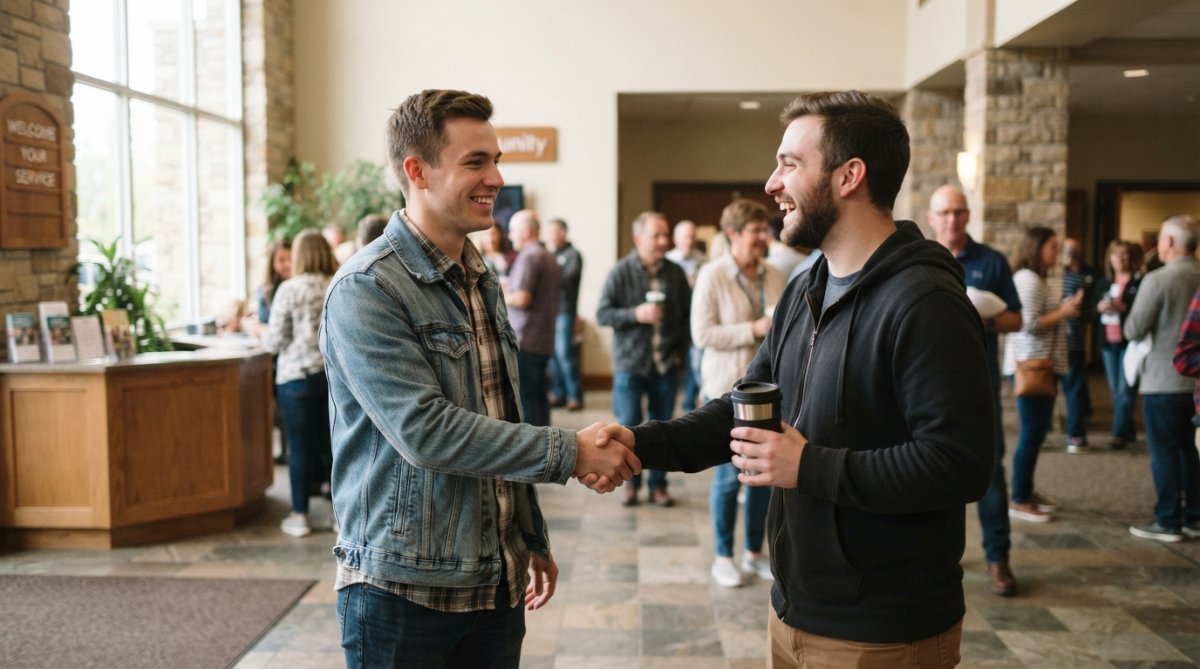
Use these exact openers the next time you are standing alone after a service:
When you want to introduce yourself: "Hi, I'm [your name]. I'm new here and trying to get more connected. How long have you been coming to this church?"
When you want to invite someone to coffee: "I've really enjoyed the messages here. Would you be open to grabbing coffee this week to chat more about it?"
When you want to join a conversation: "I couldn't help but overhear you talking about [topic]. I've been thinking about that a lot too. Mind if I join you?"
When you want to ask about small groups: "I'm looking for a small group to join. Do you have one you'd recommend, or know who I should talk to about finding the right fit?"
A common mistake is waiting for someone else to approach you. Most people in the room are just as nervous as you are. By making the first move, you are not being pushy. You are being the person who extends hospitality, which is a core part of Christian fellowship.

Vetting a Healthy Christian Community vs. a Toxic One
Not every group that calls itself a Christian community is safe to join. Learning to vet a community before you invest deeply is essential for your spiritual health. A healthy community will welcome your questions, while a toxic one will punish them.
Healthy communities display certain markers. Leaders are humble and open to feedback. Members practice vulnerability without fear of gossip. Conflict is addressed directly with grace rather than swept under the rug. You should feel challenged to grow, but never shamed or controlled. Barna Group research on church community health indicates that healthy spiritual connection is built on trust and mutual accountability.
Red flags are equally clear. Watch out for communities that demand absolute loyalty to a single leader, discourage outside relationships, or use guilt to enforce attendance. A community that isolates you from your family or non-Christian friends is not practicing biblical community. It is practicing control.
Before you commit deeply, ask yourself these questions:
- Do I feel free to disagree with leadership on non-essential matters?
- Are people honest about their struggles, or does everyone perform perfection?
- Is there evidence of outreach and service, or is the group turned inward?
If you see multiple red flags, leave quietly and find a healthier expression of the body of Christ. You are not abandoning the faith by leaving a toxic environment. You are protecting your ability to grow.
Your Next Step Toward Real Fellowship
The distance between reading about community and actually experiencing it is one conversation. You already know what to do. Now you need to decide that the temporary discomfort of introducing yourself is worth the lifelong payoff of real fellowship.
Start with one action this week. Pick a church service to attend, find a small group to visit, or wear a piece of apparel that signals your faith and see what conversations it sparks. The Part of the Crew sweater is a comfortable, everyday option that helps you make faith part of your regular rhythm without shouting.
Christian community is not a reward for being outgoing. It is a gift that God offers through the body of Christ, and it is available to you the moment you take the first step. LifeWay Research on church involvement and belonging shows that believers who connect with a local congregation report significantly stronger spiritual growth over time.
At Saved, not finished, we believe you are part of the crew whether you have found your people yet or not. We designed our apparel to help you live out loud and invite others into that same belonging. Get started with Saved, not finished today and let your faith spark the conversations that build community.
Frequently Asked Questions
Where do single Christians meet to build community?
Single Christians often meet through church small groups designed for their age or life stage, plus volunteer teams and local faith-based events. Try the church's own app or website for a list of groups. Also look for community service projects, which attract like-minded people. Don't overlook the power of simply arriving early to a service and introducing yourself. Consistency matters more than a perfect first impression.
How do I join a Christian community if I am new to an area?
Start by searching for churches near you that align with your beliefs. Most have a 'connect' or 'next steps' page online. Email their welcome team and ask about small groups or newcomer events. When you visit, mention you're new to the area. Many churches have a specific greeter role to help you find a group. Expect to try two or three churches before you find the right fit.
What does a healthy Christian community look like?
A healthy community shows real care beyond Sunday mornings. You see members helping each other with moves, meals, and prayer requests. Conversations go past surface-level greetings into honest struggles and wins. Leadership is transparent and focused on serving, not controlling. You should feel welcomed to ask questions and serve in areas that fit your gifts, not guilted into roles you didn't ask for.
How can I overcome the awkwardness of meeting new people in faith groups?
Use the 'one question' rule: prepare a single open-ended question before you go, like 'What has been keeping you busy this week?' This shifts the focus from your nerves to the other person. Volunteer for a role like greeting or coffee setup, which gives you a task and a reason to talk to everyone. Commit to attending the same group for four weeks before deciding if it is the right fit.
The challenge is clear: loneliness is a thief that steals your joy and stalls your spiritual growth. The solution is not to wait for community to find you. It is to take intentional, practical steps toward the fellowship God designed you for. Saved, not finished exists to help you express your faith boldly and connect with others who share your journey through apparel that starts conversations and builds bridges. Shop now and take your next step toward real belonging.