
Table of Contents
- Understanding Hoodie Fit Basics
- How to Measure for Hoodie Size
- Reading Size Charts and Garment Dimensions
- Should I Size Up for a Baggy Hoodie
- Best Hoodie Fit for Layering
- Fabric Composition and Shrinkage Impact
- Comparing Against a Current Favorite Hoodie
- Finding Your Ideal Silhouette
- Frequently Asked Questions
Last Updated: September 28, 2026
Understanding Hoodie Fit Basics
A hoodie that fits well becomes a wardrobe staple, while poor fit means it sits unworn. The difference comes down to understanding the three core silhouettes and how they work with your body and lifestyle.
Classic fit is the most versatile option. It sits close to your body without being tight, with sleeves that hit your wrist and a body length that reaches mid-hip. This silhouette works for layering, everyday wear, and most body types. Oversized fit intentionally drapes loose, with extra room through the chest and shoulders. It's designed for a relaxed, street-culture aesthetic and works well if you want to layer multiple pieces underneath. Slim fit tapers closer to your frame, with narrower sleeves and a shorter overall length. This style suits athletic builds and creates a more tailored look.
Proper fit ensures comfort during movement, prevents bunching when sitting, and maintains shape through washing. Poor fit leads to discomfort, premature wear, and wasted money.
How to Measure for Hoodie Size
Accurate self-measurement is the foundation of finding the right hoodie fit. You'll need a soft measurement tape and a fitted shirt to get accurate body dimensions.
Chest measurement determines your overall size. Wrap the tape around the fullest part of your chest, keeping it snug but not tight. This is your starting point for choosing between sizes.
Shoulder seam placement is critical for comfort and appearance. Stand naturally and have someone measure from the bone at the top of one shoulder to the bone at the top of the other. This is your shoulder width. When you try on a hoodie, the seam should sit right at this point. If it hangs down your arm, the hoodie is too large. If it pinches inward, it's too small. This single measurement prevents the most common fit mistakes.
Sleeve length affects both comfort and style. Measure from the center back of your neck, across your shoulder, and down to your wrist bone. This is your sleeve length. In a properly fitting hoodie, the cuff should sit just at or slightly above your wrist bone, leaving about a half-inch of your hand visible. Too short and your wrists are exposed; too long and the cuff bunches at your hand.
Body length determines where the hoodie hits on your torso. Measure from the base of your neck down your spine to where you want the hoodie to end, typically mid-hip for classic fit. This prevents a hoodie from being awkwardly short or excessively long.
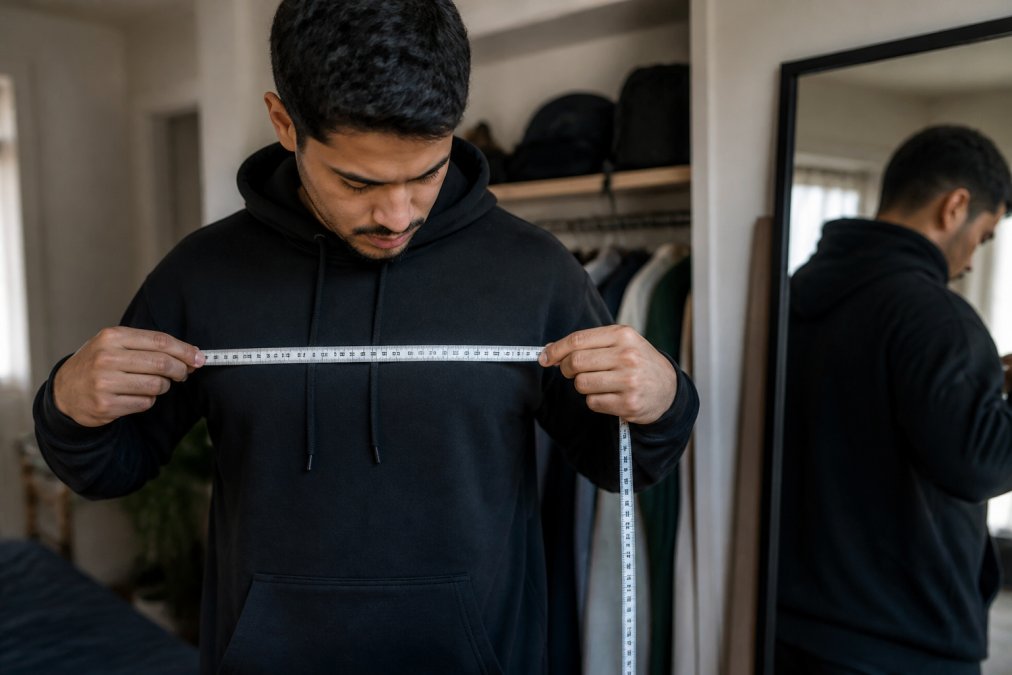
Keep the tape parallel to the ground and snug enough to fit one finger underneath. Take measurements twice to verify accuracy.
Reading Size Charts and Garment Dimensions
Learning to use a size chart correctly is one of the fastest ways to get the right hoodie fit.
A proper size chart lists body width (chest), body length, sleeve length, and shoulder width. The Saved but Hoodie in a medium offers 22 inches body width, 28 inches body length, and 34-inch sleeves; a large is 24 inches wide, 29 inches long, and 35-inch sleeves.

Compare your measurements directly against the chart. If your chest measures 23 inches and sleeves are 33.5 inches, you're between sizes, the medium fits sleeves but is snug in chest; the large fits chest but adds half an inch to sleeves.
Body length positioning matters: too long looks sloppy and bunches when sitting; too short looks outgrown. The ideal hemline sits at your hip bone or slightly below. If the size chart shows 28 inches and you measured 28 inches, that's your size.
Should I Size Up for a Baggy Hoodie
Sizing up indiscriminately for a looser fit creates problems that oversized styling doesn't solve.
Sizing up works when you want genuine oversized aesthetic. One size up adds roughly 2 inches to chest width and 1 inch to body length, giving room to breathe without looking like someone else's hoodie.
Sizing up doesn't work when compensating for a slim fit that feels tight, you end up with excess fabric, sleeves past your hands, shoulder seams hanging off, and a shapeless look rather than intentionally oversized.
The distinction matters: Oversized silhouette is a design choice where the hoodie is intentionally cut loose and the proportions still work. Poor fit from sizing up is a hoodie that's simply too large, with proportions that look off. One looks intentional and stylish. The other looks like you grabbed the wrong size.
If you want oversized fit, choose a brand that offers it as a designed option. The Saved but Hoodie comes in classic fit, so sizing up one size gives relaxed aesthetic with slightly longer sleeves.
Best Hoodie Fit for Layering
Layering is one of the most practical reasons to own multiple hoodies in different fits. The right hoodie fit for layering is different from the right fit for wearing alone.
Armhole depth becomes critical when layering. A deep armhole accommodates layers without bulk; a shallow armhole restricts movement when layering. Check the size chart for armhole measurements, or try the hoodie on with your intended layer.
Sleeve length needs adjustment for layering. Over a long-sleeve shirt, the hoodie sleeve should sit slightly above your wrist to show the shirt cuff. Over a thermal or another hoodie, slightly longer sleeves create a stacked look. Compare against a favorite hoodie that layers well and use those dimensions as your baseline.
Cuff width and fabric stretch affect layering comfort. A tight cuff bunches over long-sleeve shirts; a looser cuff accommodates layers. The Saved but Hoodie uses 1x1 rib with spandex for enhanced stretch, allowing the cuff to expand without losing shape.
A 50/50 cotton-polyester blend (like the Saved but Hoodie) breathes better than 100% cotton when layering, preventing overheating while adding durability and fit retention through repeated washing.
Fabric Composition and Shrinkage Impact
Material determines how your hoodie feels and how it will fit after washing, where many people make costly mistakes.
A 50/50 cotton-polyester blend (like the Saved but Hoodie) offers cotton comfort with polyester durability and shape retention. Cotton alone shrinks more and wrinkles easily; polyester alone feels plasticky and doesn't breathe.
Comparing Against a Current Favorite Hoodie
The most reliable way to find the right hoodie fit is to use a hoodie you already love as your baseline. This method cuts through brand variations and personal preference differences.
Finding Your Ideal Silhouette
Your ideal hoodie silhouette depends on your body type, lifestyle, and personal aesthetic. There's no universal "best", it's about matching the cut to your life.
| Silhouette | Best For | Chest Room | Sleeve Length | Body Length |
|---|---|---|---|---|
| Fitted | Athletic builds, layered outfits | Tapered | Hits wrist | Hits hip |
| Classic | Most body types, everyday wear | Comfortable | Hits wrist | Mid-hip |
| Oversized | Street-culture aesthetic, solo wear | Generous | Past wrist | Below hip |
| Relaxed | Comfort-focused, downtime | Straight sides | Hits wrist | Hip to below |
Frequently Asked Questions
How do I figure out my hoodie size?
Measure your chest width across the fullest part while wearing a fitted shirt, then compare that measurement to the size chart. Check the body width column to find your size. For example, a 40-inch chest typically maps to a Large in most standard sizing. Also measure your sleeve length from the center back neck to your wrist to ensure the sleeves hit at the right point. Always compare these measurements to the specific garment's size chart before purchasing.
Should I size up for a baggy hoodie, or is there a better approach?
Sizing up one size can create a relaxed fit, but true oversized hoodies are designed with wider body widths and longer sleeves built in. Rather than sizing up, choose a hoodie marketed as 'oversized' or 'relaxed fit' if that's your goal. Sizing up arbitrarily can result in sleeves that are too long and a hemline that hangs awkwardly. A well-designed oversized hoodie will have proportional sleeves and length for that larger silhouette, creating the boxy fit you want without excess fabric.
What's the best hoodie fit for layering?
For layering, choose a hoodie with a slightly roomier chest measurement and deeper armholes to accommodate a shirt or thermal underneath. Sleeve length is critical: aim for sleeves that end at your wrist bone when your arm is relaxed, giving you space for long-sleeve layers without bunching. A 50/50 cotton-polyester blend with spandex offers stretch and recovery, so the hoodie won't feel restrictive over layers. Check the cuff width to ensure it fits comfortably over your wrist without being too tight or loose.
Does hoodie sizing vary by brand?
Yes, sizing varies significantly between brands. One brand's Medium may fit quite differently from another's due to differences in garment construction, fabric composition, and intended silhouette. Always check the specific size chart for the hoodie you're buying rather than assuming your usual size will fit. Comparing a new hoodie against a current favorite by laying them flat and measuring chest width, sleeve length, and body length is the most reliable way to predict fit across different brands.