
Table of Contents
- Understanding Your Youth Audience and Their Faith Expression
- Choosing Meaningful Faith Messages and Bible Verse Shirt Design Ideas
- Balancing Subtle Christian Clothing with Bold Statement Design
- Christian Apparel for Teens: Selecting Wearable Styles and Formats
- Custom Christian Apparel Design: Visual Development and Graphics
- Production Specifications and Quality Standards for Faith-Based Apparel
- Testing Your Design and Measuring Real-World Impact
- Frequently Asked Questions
Last Updated: October 9, 2026
Understanding Your Youth Audience and Their Faith Expression
Designing faith-based apparel for modern youth means understanding what drives them. Today's young people don't want to wear their faith quietly. They want apparel that sparks conversation and reflects their identity.
Your audience is looking for more than a shirt. They want a statement piece that connects them to their community and shows the world who they are. This is where designing faith-based apparel for modern youth becomes powerful.
Gen Z and young adults aged 18-35 approach faith differently than previous generations (Religion Among the Millennials). They blend street culture with spiritual conviction. They're not afraid to be bold. At the same time, many want options that feel subtle enough for work or casual settings.
The key insight: your audience wants choice. Some prefer bold, graphic-heavy designs. Others want minimal, understated messaging. The best designs acknowledge both preferences.
Before you start sketching, ask yourself these questions:
- Are you designing for church youth groups, college students, or young professionals?
- Do they prefer trendy, contemporary aesthetics or timeless classics?
- What's their comfort level with visibility, conversation starter or personal expression?
- Are they drawn to specific Bible verses, or broader faith concepts?
Understanding these details shapes everything that follows. It determines your color palette, typography, messaging approach, and apparel format.
Choosing Meaningful Faith Messages and Bible Verse Shirt Design Ideas
Your message is the foundation. A powerful faith-based apparel design starts with words that matter.
Bible verses work well, but not all verses translate to apparel. Long passages get lost on fabric. Short, impactful verses become conversation starters. Consider verses like "Faith Must Mature" or "My Faith" that are short enough to read at a glance but deep enough to spark questions.

Inspirational messages beyond scripture also resonate. Phrases like "Grace Guides" or "Character Era" appeal to young people who want faith expression without direct scripture. These feel modern and accessible.
Here's what to avoid:
- Overly preachy language that feels dated
- Clichés that appear on dozens of other brands
- Messages so vague they could mean anything
- Text so small it's unreadable from arm's length
The best messages do one of three things:
- State a conviction clearly. "My Faith" works because it's direct and personal.
- Ask a question that invites conversation. A message that makes someone curious enough to ask "what does that mean?" wins.
- Offer encouragement. Messages about growth, grace, or character appeal to young people navigating identity.
Test your message with your target audience before committing to production. What lands as profound to you might feel preachy to a 22-year-old. What feels bold to you might feel subtle to them.
Balancing Subtle Christian Clothing with Bold Statement Design
This tension defines modern faith-based apparel design for youth. Some wear their faith loudly. Others prefer quiet conviction. Both are valid.
Bold statement design uses large graphics, prominent placement, and high contrast. The message dominates the front of the shirt. Someone across the room sees it immediately.
Subtle Christian clothing uses smaller graphics, minimal text, or placement on the back or sleeve. The message is there, but you have to look.
The smartest approach: offer both. A single design can exist in multiple versions. Bold placement on the chest for confident wearers. Smaller version on the back or sleeve for those preferring subtlety.
Color matters here too. Bright, contrasting colors read as bold. Monochromatic designs (single color text on matching background) feel sophisticated and understated. A design in black text on a dark grey shirt whispers. The same design in white on black shouts.
Consider your apparel type as part of this balance:
- Graphic tees: Can handle bold, large designs
- Hoodies and pullovers: Work well with back-of-neck or sleeve placement
- Minimal designs: A single word or small symbol creates intrigue
Young people often appreciate the flexibility to choose their own volume level. Some days they want bold. Other days, subtle. Offering both means your designs serve more people.
Christian Apparel for Teens: Selecting Wearable Styles and Formats
Not all apparel works equally well for youth audiences. Format matters as much as design.
Graphic tees remain the foundation. They're affordable, versatile, and forgiving. A well-designed tee works in casual settings, at church, and in everyday life. For youth, classic fit works better than oversized or fitted cuts.
Hoodies and pullovers appeal to young people who want layering options and extra comfort. These work year-round in most climates.
Accessories like hats or bags offer subtle options for those wanting minimal faith expression. A small logo or message works here.
The apparel itself matters too. Quality fabrics last through washing and wearing. Cheap fabric pills, fades, and falls apart. Young people notice. They'll wear apparel they trust.
Look for these qualities:
- Preshrunk cotton blends that maintain shape
- Double-needle stitching at stress points
- Consistent color across the garment
- Comfortable neckline that doesn't stretch out
The Faith Must Mature Tee and My Faith Tee from Saved, not finished use 5.3 oz. preshrunk cotton with double-needle stitching throughout. These details matter.

Size range matters too. Youth audiences vary in body type. Offering XS through 5XL ensures your designs serve everyone. Don't assume "youth apparel" means smaller sizes only. Many young adults wear standard adult sizes.
| Apparel Type | Best For | Design Placement | Message Length |
|---|---|---|---|
| Graphic Tee | Everyday wear, versatility | Chest or back | 2-5 words |
| Hoodie | Layering, comfort | Back neck, sleeve | 1-3 words |
| Pullover | Casual, modern feel | Chest or back | 2-4 words |
| Accessory | Subtle expression | Small, minimal | 1-2 words |
Custom Christian Apparel Design: Visual Development and Graphics
Once you know your message and format, design execution determines success. This is where faith-based apparel design for modern youth either resonates or falls flat.
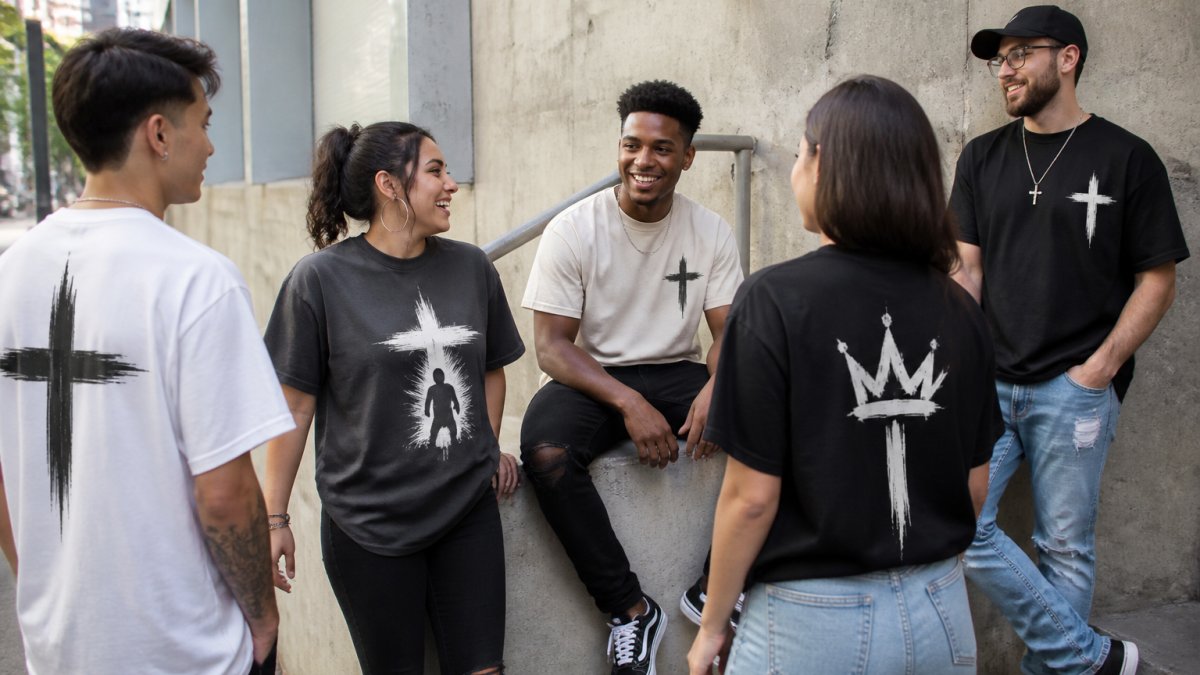
Start with typography. Font choice communicates tone instantly. A serif font feels traditional. Sans-serif feels modern. Script feels personal. Hand-drawn feels authentic.
For youth audiences, modern sans-serif or hand-drawn fonts work best. They feel contemporary without being gimmicky. Avoid fonts that feel dated or overly decorative.
Color palette shapes perception. Bright colors grab attention. Neutral colors feel sophisticated. Metallic accents add polish. Consider:
- Black and white: timeless, high contrast
- Jewel tones (sapphire, jade, emerald): sophisticated, contemporary
- Pastels: approachable, Gen Z-friendly
- Neon accents: bold, conversation-starting
Test color combinations on actual fabric samples before committing to production. Screen colors don't match printed colors. What looks perfect on your computer might look different on a physical shirt.
Graphic elements beyond text add visual interest. Icons, symbols, or minimal illustrations enhance the message without overwhelming it. A small cross, a subtle wave pattern, or a geometric shape can elevate a simple text design.
The principle: let the message breathe. Crowded designs feel chaotic. White space makes designs feel intentional and sophisticated.
Consider these design approaches:
- Minimalist: Single word, single color, simple font
- Graphic-heavy: Large illustration with integrated text
- Symbolic: Icon or symbol with small supporting text
- Layered: Multiple elements creating depth and visual interest
Young people respond to designs that feel intentional. A single, well-executed element beats a busy design with multiple competing elements.
Production Specifications and Quality Standards for Faith-Based Apparel
Design is only half the equation. Production quality determines whether your apparel becomes a favorite or ends up in a donation pile.
Print method matters significantly. Heat press transfer works well for small batches and detailed designs. Direct-to-garment printing handles full-color designs. Screen printing suits large orders and solid colors. Each method has trade-offs in cost, durability, and visual quality.
Specifications to confirm:
- Print placement: measure exact distance from neckline or bottom hem
- Design size: specify width and height in inches
- Color accuracy: provide color swatches or Pantone numbers
- Bleed area: ensure designs account for slight production variation
Quality checks before shipping:
- Inspect print alignment on first 5 pieces
- Verify color matches your approved sample
- Check for print defects, bubbles, or peeling edges
- Wash a test piece to confirm durability
- Confirm sizing accuracy against size chart
The Grace Guides Tee and Character Era Tee from Saved, not finished are made with 5.3 oz. preshrunk cotton and double-needle stitching.

Testing Your Design and Measuring Real-World Impact
You've designed something bold. Now comes the hardest part: does it actually work?
Testing reveals what you can't know from your desk. A design you love might not resonate with your audience.
Start small. Produce 25-50 pieces. Give them to a diverse group within your target audience:
- Different age ranges (18-25 versus 28-35)
- Different faith backgrounds and expression levels
- Different body types and style preferences
- Mix of introverts and extroverts
Ask specific questions:
- Does the design feel authentic to you?
- Would you wear this regularly?
- Does it spark conversations?
- What would make you more likely to wear it?
- Is the message clear or confusing?
- Does the fit work for your body type?
Observe what happens in real life. Do people actually wear it? Do they get questions? Do those questions lead to meaningful conversations about faith?
Pay attention to which designs get worn repeatedly. Which ones sit in closets. Which colors and styles appeal to different people.
Measure impact beyond sales:
- Social media mentions and tags
- Conversations started (ask wearers directly)
- Repeat purchases from the same person
- Referrals and word-of-mouth growth
- Community feedback and testimonials
Young people are honest. If something doesn't work, they'll tell you. If it does, they'll wear it and recommend it to friends.
Use testing to refine your approach. Maybe your bold designs sell but your subtle ones get worn more. Maybe certain messages resonate while others fall flat.
The brands that win with youth audiences iterate constantly. They test, learn, adjust, and test again.
Designing faith-based apparel for modern youth is about more than creating a shirt. It's about giving people a tool to express who they are and what they believe.
Frequently Asked Questions
How do you choose Bible verses for Christian apparel that will actually resonate with youth?
Select verses that speak to identity, purpose, or daily struggle rather than generic spiritual concepts. Shorter verses work better on apparel than lengthy passages. Look for verses that young people reference in their own conversations or that address themes like perseverance, authenticity, or belonging. Pair the verse with context or a modern interpretation so the message doesn't require biblical knowledge to understand. Test your selection with actual youth before finalizing the design to ensure it feels authentic, not preachy.
What makes faith-based apparel feel authentic to Gen Z instead of corporate or forced?
Authenticity comes from specificity and street culture integration. Avoid generic inspirational language; instead, reference real struggles and honest spiritual journeys. Incorporate design elements that feel contemporary: modern typography, unexpected color combinations, or minimalist layouts rather than heavily ornate religious imagery. Gen Z responds to apparel that acknowledges doubt and growth, not just victory. Include design input from actual young people in your target community so the final product reflects their aesthetic and values, not assumptions about what they should like.
How can you design Christian apparel that starts conversations without feeling too bold or preachy in everyday situations?
The key is strategic placement and visual balance. A subtle design, like a small Bible verse on the sleeve, a minimalist symbol, or a message hidden in typography, catches attention from people actively looking without overwhelming casual observers. Pair faith messaging with universal themes like 'grace,' 'growth,' or 'authenticity' that don't require religious context to understand. Test your design in different settings: work, school, social gatherings. If people ask about it, the design is working. If no one notices it exists, it may be too subtle for your goal.
What's the difference between custom Christian apparel design and mass-produced faith-based clothing?
Custom design allows for control over messaging specificity, visual style, and production quality in ways mass-produced options cannot. It allows for designs tailored to a specific audience's values and aesthetic preferences rather than fitting into a generic brand's catalog. Custom production can offer limited releases or exclusive designs that feel special to a community, whereas mass-produced apparel prioritizes volume and broad appeal over cultural fit.