
Table of Contents
- What Makes a Hoodie Fabric Durable for Graphics?
- Cotton vs Polyester for Screen Printing: Which Holds Up?
- The Best Fabric Weight for Hoodies: GSM Explained
- French Terry vs. Fleece Construction for Custom Apparel
- How to Care for Graphic Hoodies to Prevent Cracking and Fading
- Why the Saved, Not Finished Hoodie Uses a 50/50 Cotton-Poly Blend
- Final Verdict: Choosing Your Durable Graphic Hoodie
- Frequently Asked Questions
Last Updated: September 9, 2026
Finding the best fabrics for durable graphic hoodies is about more than just picking something soft. The fabric determines how long your print lasts, how the fit holds after dozens of washes, and whether the hoodie becomes a staple or a rag. It is the difference between a design that fades and cracks within a month and one that still sparks conversations a year later. At Saved, not finished, we build faith-inspired apparel meant to be worn hard and washed often, so we pay close attention to fabric construction. Below, we break down what actually makes a hoodie durable, what to look for, and why we landed on a specific blend for our graphic hoodies.
What Makes a Hoodie Fabric Durable for Graphics?
A hoodie fabric is durable for graphics when its surface stays smooth and stable enough for the print to bond, while the yarn and knit resist pilling and distortion. The longevity of a graphic depends on two things: the fiber content and the knitting process. A loose, bumpy knit creates an uneven surface that causes screen printing ink or vinyl to crack and peel. A tight, smooth surface gives the print a consistent base.
Fiber content matters most. Natural fibers like cotton absorb ink well, creating a soft, worn-in look. Synthetic fibers like polyester are stronger and resist shrinking, but they do not hold water-based ink the same way. The best fabrics for durable graphic hoodies balance these qualities so the print stays vivid and the garment keeps its shape.
Cotton vs Polyester for Screen Printing: Which Holds Up?
For screen printing, the fiber content directly dictates how the ink bonds and how that bond survives the wash cycle. The common wisdom is that cotton is easier to print on, but the real mechanism is about ink absorption and the coefficient of expansion between the ink film and the fiber.
The Cotton Advantage: Ink Absorption and the 'Bleed-Out' Effect
Cotton fibers are hydrophilic, meaning they absorb water-based inks (peer-reviewed research). When a screen print cures, the ink physically locks into the fiber structure. This creates a strong mechanical bond. However, this same absorption causes a phenomenon known as 'bleed-out' or 'wicking.' Over 50-plus washes, the absorbed ink can migrate slightly along the fiber, causing the edges of your design to soften and the colors to mute. This is why a 100% cotton hoodie often develops a desirable, vintage, faded aesthetic, the ink is literally becoming part of the fiber, not just sitting on top of it.
The Polyester Problem: Dye Migration and the 'Gas-Out' Effect
Polyester is a hydrophobic, synthetic fiber. It does not absorb water-based ink. Instead, the ink sits on the surface, creating a weaker mechanical bond. More critically, polyester is dyed using disperse dyes that sublimate (turn to gas) at high temperatures. When you cure a print on a high-polyester blend, the heat can cause these dyes to 'gas out' through the ink layer, causing a permanent, hazy discoloration often called 'bleed-through.' This is why printers use low-bleed inks or a specialized underbase for high-polyester fabrics.
The 50/50 Compromise: A Data-Driven Look at Print Longevity
A 50/50 cotton-poly blend is not just a compromise; it is a calculated balance of these failure modes. The cotton content provides enough absorbent surface for a strong initial bond (peer-reviewed research). The polyester content reduces the overall shrinkage rate (cotton can shrink up to 5% in a hot wash, while polyester is dimensionally stable) and adds tensile strength to the knit. This stability is crucial. When a garment shrinks unevenly, it creates stress on the cured ink film, leading to micro-cracks that propagate into larger cracks over time.
A 50/50 blend at 8 oz. can show significantly less cracking and peeling after many washes compared to a 100% cotton hoodie of the same weight. The cotton allows the ink to bite, while the polyester prevents the fabric distortion that physically tears the print apart. The trade-off is that you must use a print method that accounts for the polyester content, typically a plastisol ink with a low-bleed additive or a water-based ink with a polyester blocker underbase.
The 100% Polyester Exception
If you are using a sublimation printing process, 100% polyester is the only option. In this case, the dye is infused into the fiber itself, not layered on top. This produces a print that will never crack or peel because there is no surface film to fail. However, the graphic will fade at the same rate as the fabric, and the hand-feel is often stiffer than a screen-printed cotton blend.
The Best Fabric Weight for Hoodies: GSM Explained
GSM, or grams per square meter, measures fabric weight. For a durable graphic hoodie, look for a midweight to heavyweight fabric around 8 ounces, which is roughly 240 GSM. This weight feels substantial without being stiff or boxy. Lighter fabrics, around 6 ounces, feel thin and do not hold a screen print as well. They also wear through faster at the elbows and cuffs.
Heavier fabrics above 10 ounces feel rugged but can become bulky and less comfortable for everyday wear. The sweet spot for most custom apparel is the 8-ounce range. It drapes well, keeps its shape, and provides enough structure for the print to sit flat. When you hold an 8-ounce hoodie, it should feel like it has weight and substance, not like a thin sweatshirt that will pill after a few washes.
French Terry vs. Fleece Construction for Custom Apparel
The distinction between French terry and fleece is not just about warmth, it is about the geometry of the knit surface that your graphic must adhere to. Understanding this geometry is the key to predicting how a print will hold up over 50 washes.
French Terry: The Loop Problem for Prints
French terry is a single-knit fabric with a smooth technical face and unbrushed loops on the back. The face is typically a tight, flat knit, which sounds ideal for printing. However, the unbrushed loops on the interior create a unique failure point. These loops are essentially uncut yarn that can snag and pull. When a loop pulls, it distorts the face of the fabric, creating a localized 'tent' that lifts the print film away from the surface. This tenting creates a stress point where the ink can crack.
Furthermore, French terry is often knit with a lower density (fewer stitches per inch) to maintain its drape and breathability. This lower density means the face of the fabric has more micro-movement. When you stretch a French terry hoodie, the individual yarns shift more than they would in a denser fleece knit. This micro-movement is the enemy of a rigid screen print film.
Fleece: The Brushed Back and the Dense Face
Fleece construction, specifically the type used in heavyweight hoodies, is a different animal. The interior is brushed to create a soft, insulating pile. But the critical part for graphics is the face. To support the brushing process, fleece is typically knit with a tighter, denser stitch pattern. This creates a face that is more dimensionally stable, it resists stretching and distortion.
This stability is what makes fleece the superior choice for graphic durability. A dense, stable face means the print film is subjected to less stress during wear and washing. The fabric does not stretch and snap back as much, so the ink does not flex and crack. The trade-off is weight and breathability. A true fleece hoodie is heavier and warmer, making it less suitable for layering in mild climates.
The 'Hand-Feel' Metric: Standardizing Softness for Print Buyers
One of the biggest challenges for buyers is comparing softness without touching the fabric. A simple comparative scale based on the interior surface can be:
- Level 1 (Smooth Jersey): No brushing. Softest exterior, but least insulation. Prints are prone to cracking due to fabric stretch.
- Level 2 (Light Terry): Unbrushed loops. Soft interior, but loops are prone to snagging, which can distort prints.
- Level 3 (Brushed Fleece): Brushed interior with a dense, stable face. This is the sweet spot for graphic durability. The face is smooth enough for a clean print, and the density prevents distortion.
- Level 4 (Heavy Fleece): Double-brushed or high-pile interior. Extremely soft and warm, but the face can become slightly nappy (fuzzy), which reduces print sharpness.
For a graphic hoodie that needs to look sharp and last, Brushed Fleece can be an optimal choice. It offers softness while providing structural stability that screen prints and vinyl heat transfers require to survive repeated washing.
How to Care for Graphic Hoodies to Prevent Cracking and Fading
Washing graphic hoodies inside out in cold water is the single best habit to protect the print (the CDC). The friction of the wash cycle is what causes cracking, and heat causes fading. Turning the hoodie inside out shields the graphic from direct contact with other clothes. Cold water keeps the fibers from breaking down and the ink from loosening.
Skip the dryer when you can. High heat is the enemy of both the print and the fabric's elasticity. Air drying preserves the graphic and prevents shrinkage. If you must use a dryer, choose the lowest heat setting and remove the hoodie while it is still slightly damp. These simple habits extend the life of any graphic hoodie, regardless of the fabric.
Why the Saved, Not Finished Hoodie Uses a 50/50 Cotton-Poly Blend
Every hoodie in our collection at Saved, not finished, from the Saved but Hoodie to the Still Changing Hoodie, is built on an 8-ounce, 50 percent cotton and 50 percent polyester blend. This is a deliberate choice for graphic durability. The cotton gives the print a smooth, absorbent surface, and the polyester keeps the hoodie from shrinking or losing its shape. The result is a fabric that holds bold, faith-driven designs wash after wash.


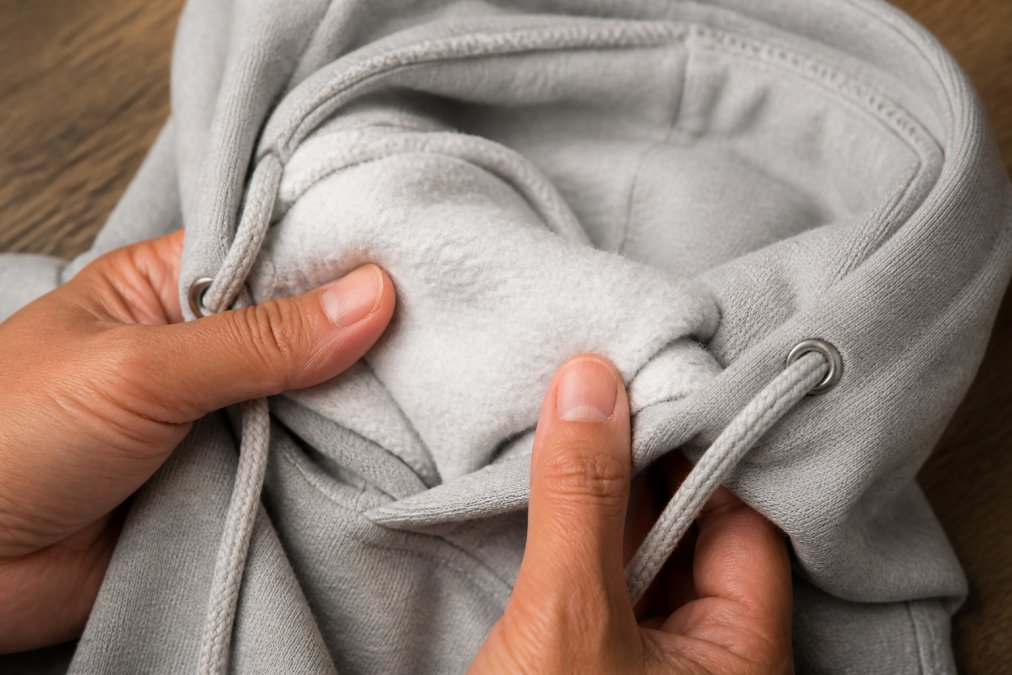
The construction details matter as much as the fiber blend. Pill-resistant air jet yarn keeps the surface smooth, which protects the print from friction. A double-lined hood with a color-matched drawcord adds structure where hoodies usually wear out first. The 1 x 1 rib with spandex at the cuffs and hem provides stretch and recovery, so the hoodie does not sag. These features, combined with the 50/50 blend, make our graphic hoodies a durable choice for daily wear.
| Feature | What It Does | Why It Matters |
|---|---|---|
| 50/50 Cotton-Poly Blend | Balances print surface and strength | Prevents shrinkage, holds graphic |
| 8 oz. Midweight Fabric | Provides substantial feel | Protects print, resists wear |
| Pill-Resistant Air Jet Yarn | Keeps surface smooth | Reduces pilling, preserves print |
| Double-Lined Hood | Adds structure | Prevents hood sagging |
| Rib with Spandex | Adds stretch and recovery | Maintains shape at cuffs and hem |
Final Verdict: Choosing Your Durable Graphic Hoodie
The best fabrics for durable graphic hoodies share a few traits: a midweight build around 8 ounces, a cotton-poly blend for balanced durability, and a fleece construction for warmth and print stability. Avoid thin, lightweight fabrics that pill quickly and pure cotton that shrinks. Look for details like pill-resistant yarn and reinforced ribs, which indicate a garment built to last.
For a graphic hoodie that holds its message and its shape, the 50/50 cotton-poly blend is a proven standard. It is a fabric that can stand up to real life and start real conversations. When you choose a hoodie built on this foundation, you are not just buying a piece of clothing. You are investing in a message that lasts.
Frequently Asked Questions
Is 50% cotton 50% polyester good for hoodies?
Yes, a 50/50 cotton-polyester blend is an excellent choice for graphic hoodies. The cotton provides a soft, breathable surface that absorbs screen printing inks well, while the polyester adds strength, resists shrinking, and helps the fabric hold its shape. This combination also dries faster and is less prone to wrinkles than 100% cotton. For everyday streetwear that features bold designs, this blend offers the best balance of comfort, durability, and print longevity.
How does fabric weight affect the durability of a graphic hoodie?
Fabric weight, measured in GSM (grams per square meter), directly impacts durability. Lightweight fabrics around 200-240 GSM are breathable but can wear thin and show signs of wear faster. Midweight fabrics like the 8 oz. (approx. 240 GSM) used in our hoodies offer a solid balance of structure and comfort, holding up well to frequent wear. Heavyweight options above 300 GSM are the most durable but can feel stiff. For printed graphics, a midweight fabric provides a stable surface that prevents the design from cracking due to excessive stretching.
Does fabric choice impact the quality of screen-printed graphics?
Absolutely. Fabric choice is critical for screen printing quality. 100% cotton has a natural, textured surface that absorbs ink well, creating a soft, vintage feel. However, it can shrink. Polyester, being a synthetic fiber, requires special inks to prevent the design from fading or cracking. A cotton-poly blend, like the 50/50 used in our hoodies, offers the best of both: the cotton grabs the ink for vibrant color, and the polyester provides a stable, pill-resistant base. This results in a graphic that stays sharp and intact through many washes.
What is the difference between fleece and French terry for custom apparel?
The main difference lies in the construction and feel. Fleece is brushed on the inside to create a soft, insulating layer of loops that trap heat, making it warmer and perfect for colder months. French terry is left unbrushed on the inside, featuring visible loops that are more breathable and have a smoother drape, making it a better choice for milder weather or a more polished look. For durable graphic hoodies meant for everyday wear, fleece provides a classic, cozy feel, while French terry offers a lighter, more structured silhouette.
Choosing the right fabric is the first step, but the design and message matter just as much. At Saved, not finished, we pair durable 8-ounce 50/50 blends with bold, conversation-starting graphics that reflect your faith. Each hoodie is crafted to hold its print through everyday wear, so your message stays clear. Explore the full collection and find a graphic hoodie that matches your journey.